Have you seen that terrifying movie, We Need to Talk About Kevin? 😅 No? Just me?
Well, it’s a psychological thriller about a boy named Kevin and it doesn’t go well. I’ll just leave it at that 😉
AI isn’t exactly a deranged person, but there are some truly disturbing things about its proliferation that I don’t see ANYONE talking about.
And so, we need to talk about it.
If you’re here, you already know I’m a wildlife nut and am deeply involved in how we can live more sustainably even in a world that’s now designed to make that really hard.
So it’s likely no surprise that I have dug into the environmental implications of AI use.
I don’t know about you, but it feels like 3 days ago someone said, “Hey – AI is kinda cool and this thing called Chat something or other can answer your questions.”
And today everyone and their mother are using AI tools like ChatGPT, Gemini, and CoPilot

Look, I get it. Technology can be cool and useful and even fun. So, this isn’t a rant on how we need to go back into the dark ages and never use anything ever again.
But it is a closer look at what is actually happening with this explosion of AI use (is there really any better metaphor in this case?).
I’m going to dive into the various pieces that make up this AI-environment soup and then give you simple, practical tips on how you can use AI more sustainably. If you’d like just those tips, skip to the end!
A Quick Science Lesson 🧪
Do you remember Newton’s Third Law of Motion from high school physics? It’s the one that states for every action in nature, there’s an equal and opposite reaction.
And what about the Laws of Thermodynamics? The first law states that energy cannot be created or destroyed, only transformed or transferred.
I think both of these concepts are important to keep in mind as we discuss the impacts of AI because this isn’t magic (even if it feels like it is) and so the energetic requirements of AI must follow the laws of motion and thermodynamics, too.
What Does Physics Have to Do With AI?
Ok, so hear me out.
I’ve noticed something really interesting about AI use. Right now, it’s being sold as the Answer to Everything with no downside.
I’m sorry, but don’t we all know that if it sounds too good to be true, it usually is? 😬
If we step back just a little and look at what is happening here, you too may join my bandwagon.
Fundamentally, AI quickly processes the internet of information and creates summaries of what it finds, based on parameters set by the user. It can predict or suggest or edit or create.
All of that work requires energy. And if you consider the amount of human energy it would require to sort and sift all of that information and then distill it into something resembling coherence, you’re probably tired already.
I know we don’t often consider technology from the lens of human output, but if you really think about it, that’s what it streamlines.
As I type this, the computer and word processing has made writing much faster and easier. Back in the day, I would have had to pen this with a quill and ink that may have been difficult to source.

What takes 15 minutes or less to write today, say an email to a colleague, may have taken a week or more before technology intervened.
What I think is lost often is that the ENERGETIC requirement is still there, it’s just been transferred to non-human sources.
Yes, energetic requirements have gotten more efficient over time. But, as the Laws of Thermodynamics state, that energy is not “destroyed.”
So, it has to go somewhere.
And, if we tie in Newton’s Laws of Motion – for every action, there’s an equal and opposite reaction – we can start to see that the impacts of AI MUST exist.
We also might not consider typing a question into ChatGPT as a traditional “action,” but in reality, it is. We are still acting on our environment. Using energy in some capacity, transferring that energy, and ultimately doing something with it.
Which means that each of those actions has an equal and opposite reaction…somewhere.
If almost overnight we exponentially increased our energy use on systems like AI – where is all that energy being stored? How is it being used? What “equal and opposite” reaction is it having?
Let’s Break It Down
1. The Cost of Energy
We can start super basic and with something I think everyone can instantly understand.
Many power companies in the US are for-profit entities (don’t get me started on this!).
If there is a new energy requirement to process the immense amount of data required for a simple ChatGPT query, and EVERYONE is doing this, it naturally increases the amount of energy needed from said power companies.
Who do you think is going to pay for that?
I promise you, the power companies are not interested in eating those costs. Neither are the companies creating AI tools. WE will pay for this.
“…training a single chatbot like ChatGPT uses about the same amount of energy as 100 homes over the course of a year.” – Paige Gross, Washington State Standard
2. More Thermodynamics – Heat as a Byproduct
I bet you didn’t think we were going to revisit all of these fun physics lessons, did you? 🤓
Picture this: you just asked ChatGPT to describe you like your bestie would (side note, please stop doing this lol). It thinks for a few seconds and then, like magic, a cute little description of who you are, what makes you amazing, and a reminder that you’re capable of anything pops onto the screen.

Somewhere in real life, that inquiry travelled to a data processor, which did its thing to scour the internet and use your guidelines to craft that statement.
As we discussed, that requires energy and since energy can’t be destroyed, it gets transferred somewhere. And in this case, it becomes heat.
Now multiply this times however many zillions of inquiries a day and I bet you can image the type of heat this is generating.
To cool these processors, data centers use water. That isn’t the most environmentally friendly way to handle this issue and causes water resource concerns. In a world with increasing climate impacts to natural resources, this is yet another concerning element of AI use, especially in the short amount of time it has proliferated.
“A hyperscale data center can use up to 200 million gallons of water per year for cooling, making sustainability a critical challenge.” – bsi Whitepaper
For scale, this is like adding about 2,000 American households PER DATA CENTER in terms of annual water consumption. Current estimates show about 1,189 hyperscale data centers (this doesn’t include regular data centers) globally in 2025.
This equates to 2,378,000 additional households, or nearly 238 BILLION gallons of water per year.
3. Physical Infrastructure
It’s really easy to believe that the “internet” and AI and all things digital exist in the ether…but they actually exist on the ground here on planet Earth.
The cloud isn’t actually a cloud, my friends 😂☁️
As I mentioned, all of this computing requires a physical place to work. This is being accommodated in the form of giant data centers.
If you aren’t at least a little alarmed yet, the growth rate of data centers is expected to double in global capacity by 2030 😬
Data centers are being built to keep up with the demand and each of those facilities are not only large (on average 100,000 square feet and up to 1 million square feet), but are also impacting wildlife corridors.
Developments of this size are hard on the planet in general, and when I consider why these things are being built, I don’t feel great about it. I mean, do we really need to have AI create a fun playlist or tell us things that are funny or whatever other weird and totally unimportant things people are asking it these days?
Especially when doing that is creating an enormous amount of issues for our precious environment? That’s a hard pass for me.
4. Energy Sources – GHG Emissions & Climate Change
Ok, so at this point you probably have already guessed that most data centers are using fossil fuels for energy.
I think it’s fairly clear that this energy demand is enormous and so the use of non-renewable energy sources in a climate that’s already struggling with current emissions is not the best idea.
If you’re not familiar with the impacts of increased greenhouse gas (GHG) emissions on climate change, check out this resource for a quick refresher.
5. Increased Consumerism & Data Mining
So this might not be on your radar from an environmental standpoint but it’s all related, I promise.
Most AI tools use your information to sell you things.
I know we’ve learned that capitalism is equated with progress, and progress is “good,” but that’s all mostly a lie. Buying things you don’t need because companies were able to socially engineer your world so you always feel slightly bad about yourself is manipulation, not progress friends.
Plus, all of that extra junk ends up in our landfills which pollute our watersheds and our bodies by proxy. Not to mention that it keeps you broke in the process!
It might sound weird and I know there’s A LOT of our data already out there being used against us, but AI tools are another method for collecting this data and using it so that the companies profit…and you and the environment suffer.
TL;DR
Here’s the gist: the proliferation of AI has massive environmental impacts, including use of water resources to cool processors, physical infrastructure impacts on local wildlife corridors, and exponentially increased greenhouse gas emissions. The cost of this massive increase of energy will be passed down to consumers, and they will use your information to sell you products or services you don’t need, doubling the total monetary cost to users.
If you’re skeptical and maybe now angry/paralyzed/overwhelmed, I got you 😊
Look, I’m not saying we can’t use AI and I’m not naïve enough to think this development is going to halt. But I do think we can use this technology better and not as frivolously so that we reduce these demands.
Let’s see how:
Practical Solutions
After my initial panic attack subsided post researching all of these things, I decided to see what I could do instead.

Here’s a quick list of tips that will help to reduce your AI use impacts:
Friends – this company is a legit game changer 😍 I am SO STOKED that they exist for many reasons.
1️⃣ First, they’ve partnered with hosting companies that are siting their processors in urban environments and capturing the heat generated to WARM BUILDINGS instead of doing nothing with it. This includes hospitals, senior centers, and pools 🤯
Pure genius if you ask me! Check out Leafcloud if you’re curious what this looks like.
2️⃣Second, they use 100% renewable energy. ‘Nuff said!
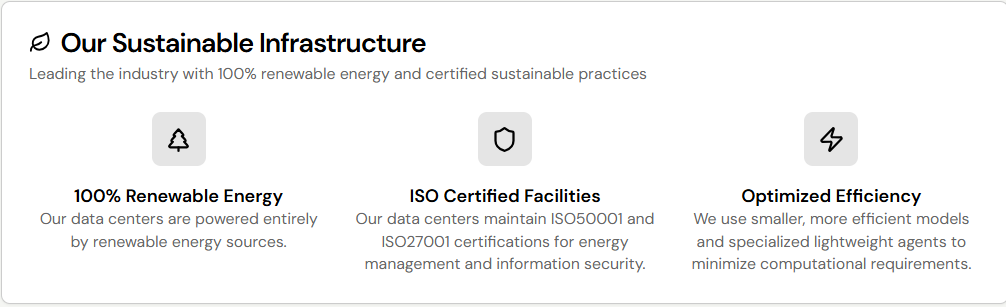
3️⃣Third, they are located in the EU and have much stricter privacy laws than US-based operations. They also allow you full control over what data is being used in a clear, upfront way ☺️ If you’re concerned at all about your own Intellectual Property or just how your own data may be used against you, this really helps to lessen that issue!
4️⃣Fourth, the chat interface includes a cute indicator bar that tells you how energy-friendly you’re being with your prompts, equipped with emojis and all 🥳 It’s a great visual way to see if you need to be more succinct with your inquiries (more on that below), plus it’s fun!
If those things weren’t enough to sway you already, they are also rolling out some new features that are really incredible to help reduce energy requirements of each chat/prompt. These peeps are super smart and recognized that we all need some help with how we use AI, so they put their big brains together so we can use ours on different things!
If you sign up through my paid link, you’ll get 14 days to try all of these features out for free.
Pricing starts around $5/month for the basic plan and around $17/month for the Pro plan (don’t quote me, their prices are in Euros and I can’t promise exact currency exchange rates lol), so they are very competitive with those other AI tools 😉
If you sign up through my link, I do get a small commission and, although I think that’s really cool and I’m really, really excited to be their partner, I am only recommending them because I use this tool myself and found it during my anxiety-riddled deep dive into how I can not f*$# up the planet while running a business 🤣
2. Prompt Responsibly
Something else I learned about AI tools during said anxiety-riddled deep dive was that how we are asking questions in chats actually matters!
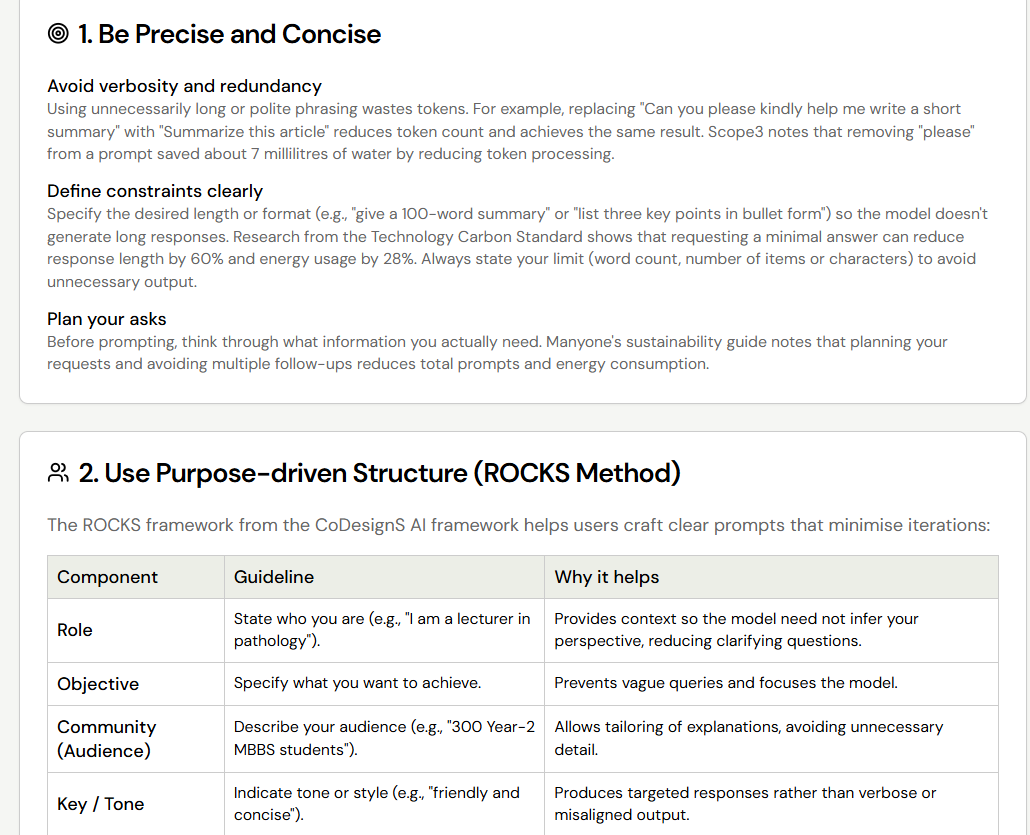
It makes sense if you think about it – the more fluffy language you use to ask questions (e.g., “oh heyyy chat! How are you today? Could you do me a huge favor and blah blah blah”) the more energy it requires to process 🤦🏼♀️ oops!
So instead of doing that, get specific. Obviously I have a love affair with GreenPT, so here’s yet another reason to love them – they provide fantastic resources to help you ask better questions.
Here’s a little sample of what you can find under the Sustainable Prompting tab of the Documentation section:
You can also find information on how to reduce your energy demands when prompting by reading these resources:
Think before you prompt: Reduce your AI carbon footprint with ROCKS
Substack: How to Reduce Your AI Carbon Footprint - 8 Practical Steps for Sustainable Use of Generative AI
3. Offset Your Energy Use
Maybe you’re in too deep with those other tools and switching isn’t in the cards (yet). Besides learning about how you can prompt better/more efficiently, consider offsetting your energy use by contributing to projects that help pull carbon out of the atmosphere.
If you’re a business (or you’d like your employer to do something about this too), I highly recommend Rewild Carbon. I use Rewild Carbon for my business and they are incredible to work with and their projects are not only amazing, but they are super transparent about what is happening with your dollars. Check them out here (I do NOT receive payments for referrals, I just love them 💖).
If you’re a regular everyday person, check out TerraPass and consider setting up a monthly contribution based on their general calculations or calculate your own specific carbon footprint and offset that. I’m not sure how carbon footprint calculators will change in light of AI use, but I’ll keep you updated! (I also do NOT receive payments for referrals to TerraPass, I’ve just found them to be one of the easiest and most transparent of the carbon offsetting bunch).
Important Note: the world of carbon offsetting is messyyyyy. I cannot claim to be an expert here in all capacities because there is SO MUCH, but I have done quite a bit of research and have a decent understanding of what the heck happens in this space.
With that said, please understand that offsetting a carbon footprint does not give anyone carte blanche to pollute or trash or destroy nature 😅 This helps, for sure, if trusted organizations are really doing work to help sequester carbon. But please also consider how you can still walk a bit more gently upon our planet each and every day 🌱
So, that’s it for our talk about AI (at least for now lol). I’d love to know – was this helpful? Do you have other questions? Shoot me an email, or ask me a question here, and let’s chat!
New here? Grab my free 3 Simple Actions guide or sign up for my newsletter directly and get this wealth of knowledge straight to your inbox!